
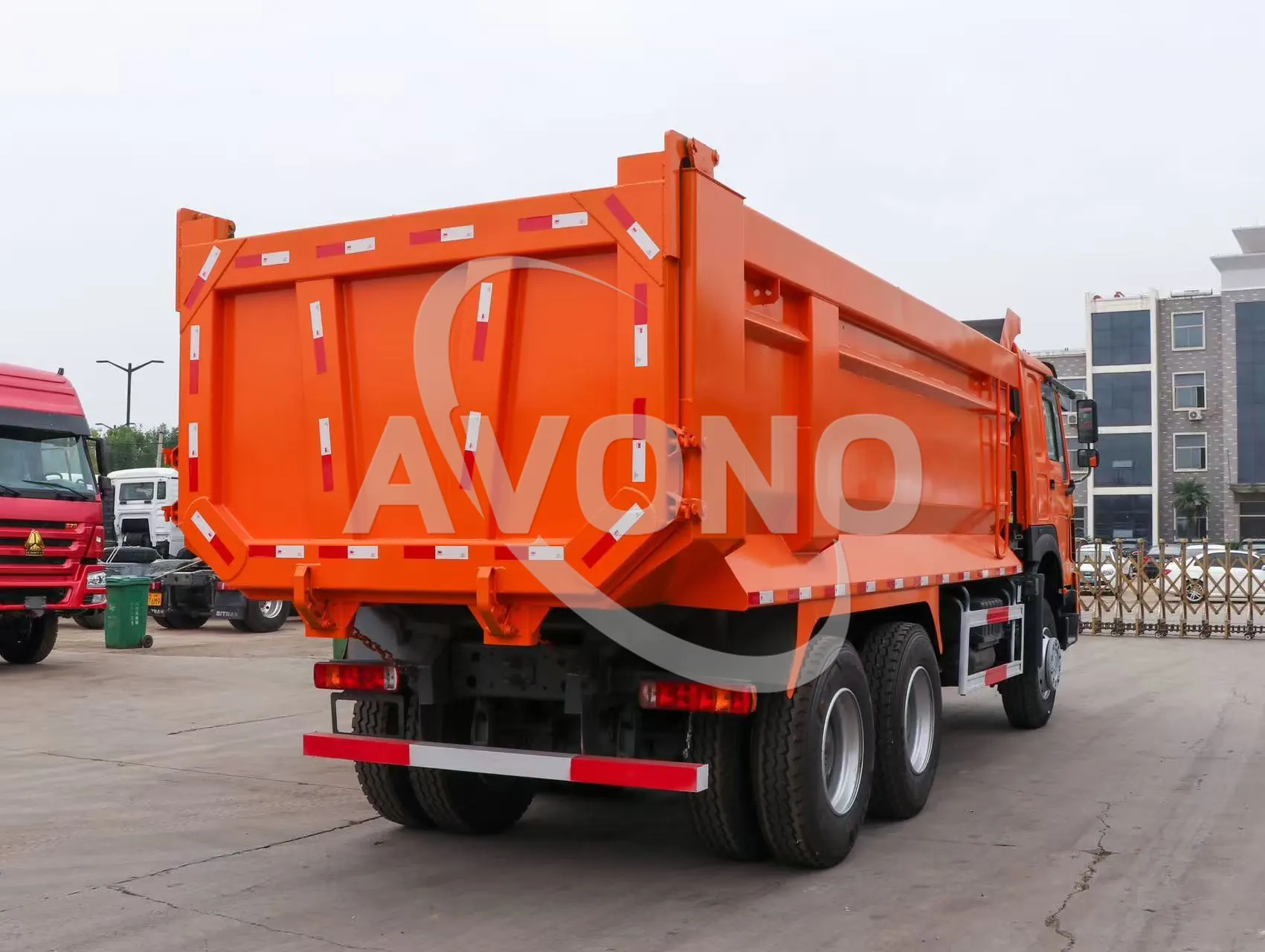
On paper the two trucks look almost the same: 6x4, right-hand drive, Euro II, rear-tipping body around five metres long, roughly twelve and a half tonnes of kerb weight. The differences that matter on site are in the engine family, the gearbox and how thick the steel in the dump box is.
Specification comparison
| Item | HOWO-7 371HP (SINOTRUK) | Shacman SX3255 380HP |
|---|---|---|
| Overall dimensions | 8,500 × 2,550 × 3,300 mm | 8,500 × 2,490 × 3,450 mm |
| Drive / steering | 6x4, RHD | 6x4, RHD |
| Wheelbase | 3,625 + 1,350 mm | 3,775 + 1,400 mm |
| Track (front / rear) | 2,020 / 1,860 mm | 2,020 / 1,860 mm |
| Kerb weight | ≈ 12,500–12,600 kg | ≈ 12,500 kg |
| Engine | WD615.47, 371 HP, Euro II (Premium refurbishment: Weichai WP10.5H) | Weichai WP10.380E22, 380 HP, Euro II |
| Gearbox | SINOTRUK HW19710 / HW19712CL, 10F + 2R | FAST 10JSD180, iron housing, 10F + 2R |
| Rear axle ratio | ≈ 5.92 | 5.92 |
| Dump body | 5,000 × 2,350 × 1,500 mm — floor 8 mm manganese, sides 6 mm, five bottom beams | 5,000 × 2,350 × 1,500 mm — floor 10 mm, sides 8 mm |
| Hydraulic cylinder | Hyva 180-75 type | Hyva 180-75 type |
| Frame | 8 + 5 / 300 mm | 850 × 300 mm, double layer 8 + 7 mm |
| Front axle | VGD95 9.5 t (VPD75 on some builds) | Man 7.5 t class |
Figures are typical published specifications for these models and may vary by build year and refurbishment package — confirm the exact numbers on the quotation.
What the difference means in practice
Engine and emissions
Both sit in the Euro II mechanical-injection camp, which is the sweet spot for most export markets: no fragile after-treatment, tolerant of variable fuel quality, and repairable by any competent diesel mechanic. The Shacman carries roughly ten more horsepower, which you will not feel on a loaded haul — that difference shows up as a small edge on steep ramp climbs rather than as more speed.
Gearbox
The HOWO uses the in-house HW19710 (or HW19712CL on some builds); the Shacman runs the FAST 10JSD180 with an iron housing. Both are well proven. Choose on parts availability in your country — whichever brand your local truck market already stocks is the cheaper one to own over five years.
Dump body — the real difference
Here the Shacman is genuinely heavier-built as published: 10 mm floor and 8 mm sides versus 8 mm and 6 mm on the HOWO. If your truck loads blasted rock in a quarry, that extra plate thickness is worth real money in body life. If you move sand, gravel, spoil or agricultural bulk, the HOWO body is adequate and the lighter box leaves more payload within the same gross weight.
Parts and service network
This usually decides the purchase, and it is a local question, not a factory one. Count how many HOWO and Shacman trucks already work in your region, and which parts your city's truck shops keep on the shelf. A truck that waits three weeks for a clutch kit costs more than the specification difference between the two brands.
Quick decision guide
- Hard rock, sharp blasted material, abrasive loading → the thicker-box specification (Shacman 10/8 mm, or a HOWO with upgraded plate).
- Sand, gravel, earthmoving, road works → the HOWO-7 371HP, which is usually the more economical buy.
- Your region runs mostly HOWO → stay with HOWO; common parts and common mechanic knowledge beat any spec sheet.
- Dusty mining site → look for the engineering-version intake (oil-bath air filter), which survives dust far better than a paper element.
Check the HOWO-7 371HP in detail
Full specification, refurbishment list and real yard photos of the refurbished HOWO-7 6x4 dump truck.
See Full Specifications